Early years
Hideouts and first tunnels
Before the great network
See the toursPick out your stop
Cu Chi tunnels and Mekong day from Ho Chi Minh City
★ 4.7 · 13,778 guest reviews
Find out about 15 stops
Select a route, then tap a marker or stop to see its note and open Google Maps.
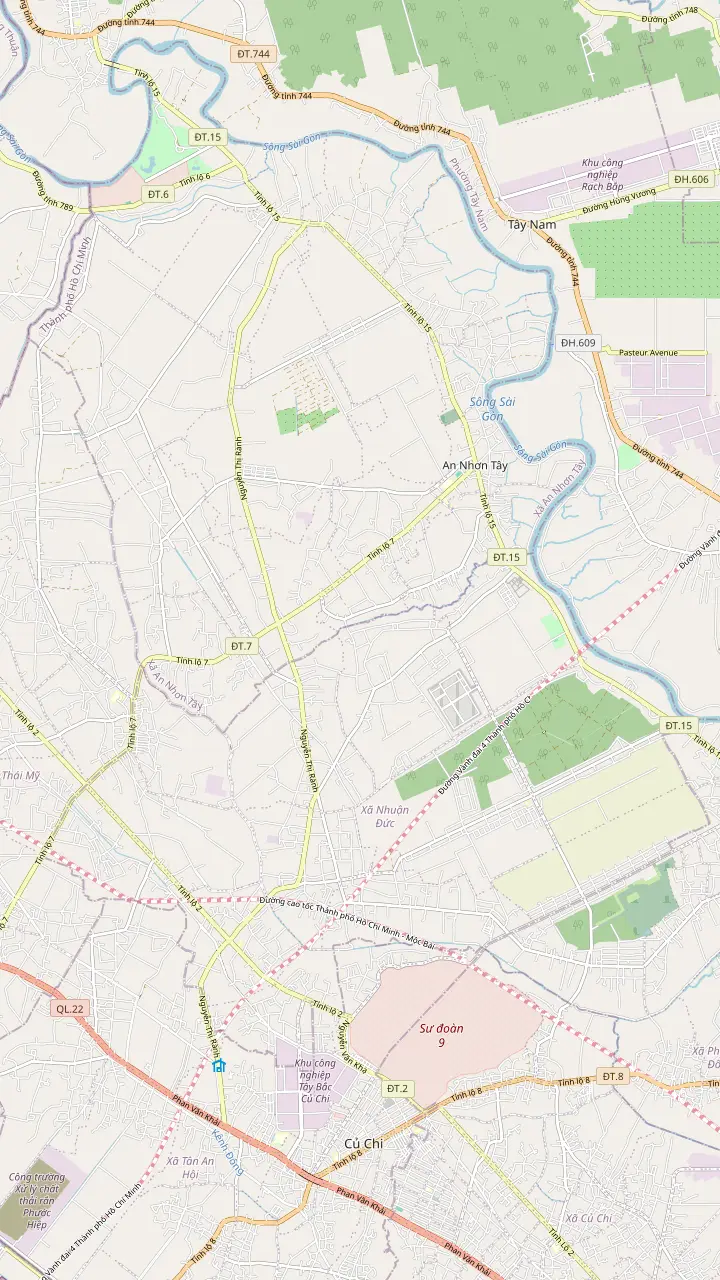
Ben Duoc was the base of the Saigon - Cho Lon - Gia Dinh command, and was recognised as a national relic on 29 April 1979.
Google MapsThe memorial temple has the largest ceramic mosaic in Vietnam, on 3 wall faces, and a 9-storey tower.
Google MapsBen Dinh lies on Provincial Road 15 and was the base of the Cu Chi district committee.
Google MapsCu Chi bus station is the change point on the relic site's directions for bus 79 to Ben Duoc.
Google Maps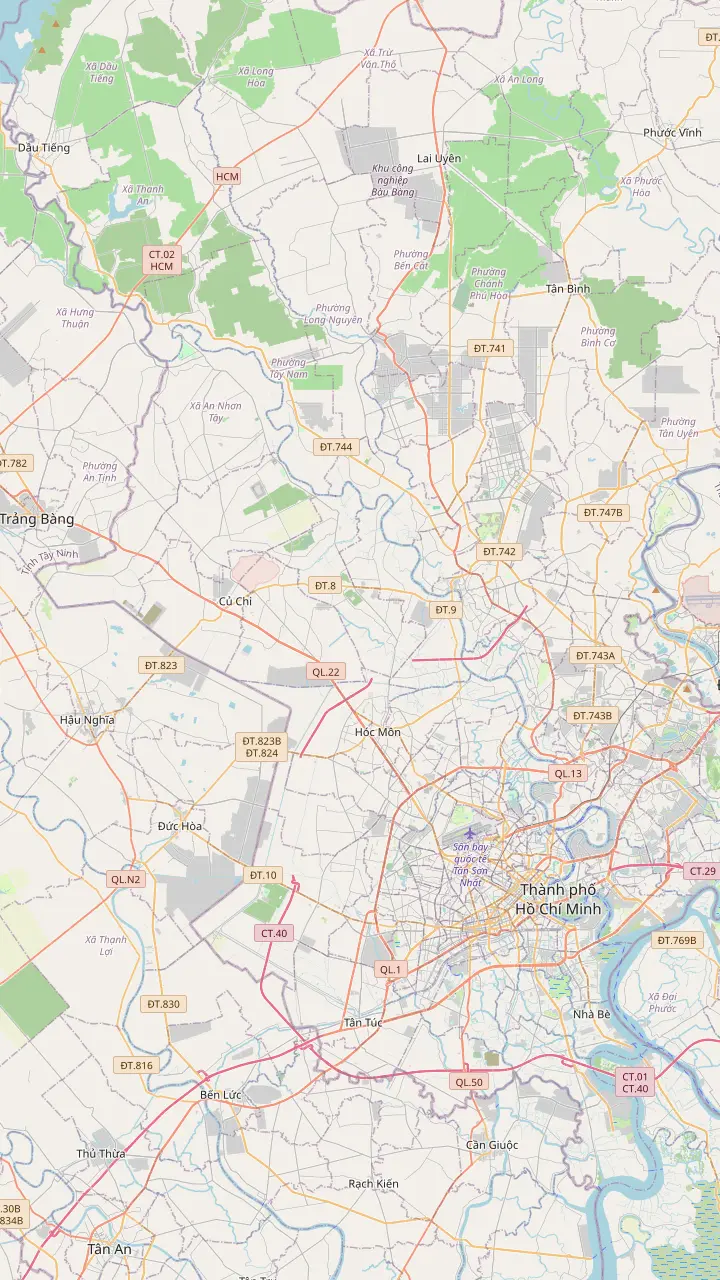
Ben Thanh Market is where bus 13 starts for the tunnels, and one of the pickup points of the site tour.
Google MapsCho Lon bus station is the start of bus 94 to Cu Chi bus station.
Google MapsAn Suong bus station is where bus 13 from Ben Thanh changes to bus 122 for Ben Dinh.
Google MapsTan Quy bus station is where bus 122 changes to bus 70 for Ben Dinh.
Google MapsCu Chi bus station is the change point on the relic site's directions for bus 79 to Ben Duoc.
Google MapsBen Duoc was the base of the Saigon - Cho Lon - Gia Dinh command, and was recognised as a national relic on 29 April 1979.
Google MapsBen Dinh lies on Provincial Road 15 and was the base of the Cu Chi district committee.
Google Maps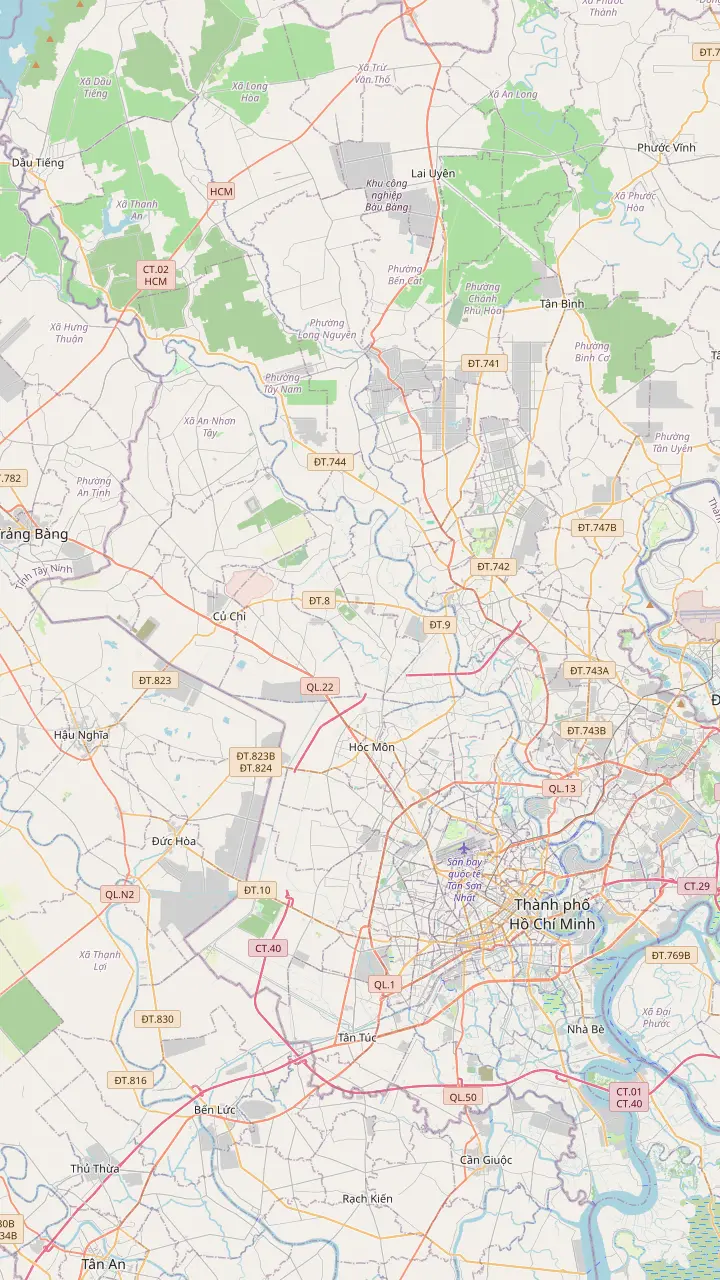
Bach Dang pier is the starting point the relic site names for the river route to the tunnels.
Google MapsBen Thanh Market is where bus 13 starts for the tunnels, and one of the pickup points of the site tour.
Google MapsBen Duoc was the base of the Saigon - Cho Lon - Gia Dinh command, and was recognised as a national relic on 29 April 1979.
Google MapsBen Dinh lies on Provincial Road 15 and was the base of the Cu Chi district committee.
Google Maps© OpenStreetMap contributors, map data
From single-entrance shelters to a system of floors, hatches and kitchens, then the sweeps, the preserved sites and the questions worth asking your guide, all from official accounts.
Editorial team, cuchiandmekongtour.com · Updated November 16, 2026 · 8 mins to read
In brief
A Cu Chi tunnels historical tour is easier to follow if you know where the story starts, and the relic site's own account starts before the tunnels have a name. During the resistance to French rule in 1945 to 1954, fighters hid in secret underground shelters behind enemy lines, protected by villagers.8 A shelter was mostly buried, with a single entrance just wide enough for a person's shoulders and an air hole to breathe.9 It worked until someone found it. The relic's account is that a found shelter was easy for a larger force to surround or destroy.10
From that weakness came the idea of extending a shelter into a tunnel with several secret exits to the surface.11 In Cu Chi the earliest tunnels date from 1948, in the communes of Tan Phu Trung and Phuoc Vinh An.1 At first they were short, simple sections used to hide documents and weapons and to shelter cadres working behind enemy lines.12 From 1961 to 1965 guerrilla warfare in the district grew strongly, in the relic's telling.13 The 6 northern communes then completed a main backbone line, and branch tunnels were joined to it.14
The labour was done with very simple tools, hoes and bamboo earth scoops, as the relic site describes it.15 The earth was the hard part to hide, and it went into water-filled bomb craters, into mounds, or onto fields that were ploughed and planted over.16 That detail is worth carrying to the site. The quiet fields and tree lines around the tunnels hide the work of years, and a broken blade of grass near an entrance had to be put right or the entrance could be found.17
Sites compared
| What | Ben Duoc | Ben Dinh |
|---|---|---|
| Base of | Saigon - Cho Lon - Gia Dinh command35 | Cu Chi district committee36 |
| Relic status | 29 April 19795 | 15 December 20046 |
| Distance, portal | 70 km37 | 35 km37 |
| Signature sight | Memorial temple and tower38 | Tunnel under the road39 |
| Also on site | Cedar Falls sand-table40 | The M41 tank wreck41 |
Status dates from the relic site; distances as quoted by the portal. The Ben Dinh entrance is on Provincial Road 15.36
By the time of the large sweeps the system was big. The relic site gives a total of about 250 km by 1967,2 while a state news agency says some 200 km of tunnels and 500 km of combat trenches had been dug by 1965, in a system of 3 floors.22 The floors lie about 3 m, 6 m and 8 to 12 m deep,23 and the relic notes that some sections have 2 to 3 levels linked by secret hatches.24,25 Read together, the accounts describe a network that grew in depth as well as in length, which is the picture to hold on any Cu Chi tunnels Vietnam underground tour.
The tunnels did not stand alone. The relic lists trenches, fighting positions and rooms for eating, sleeping, meetings, daily life, military medicine and food storage, with wells and the Hoang Cam kitchen,26 and describes strong A-shaped shelters for women, older people and children.27 Resting rooms were big enough to hang hammocks.28 Beneath tunnel sections in dangerous areas lay spike pits, nail pits and other traps,29 and the ventilation holes were camouflaged on the surface.30
Life underground was hard, and the relic site does not hide it. Movement was difficult in the dark, cramped space, mostly bent over or crawling.31 In places the air was thick and wet, with little light beyond candles and torches.32 In the rainy season harmful insects appeared, and in places snakes and centipedes.33 When you crawl through a restored section, remember that these walls were home to people for long stretches, not only a place to hide for an hour.
The relic's account names 2 large operations. Operation Crimp ran from 8 January to 19 January 1966, with 12,000 ground troops.18 The relic site says the attackers pumped water into the tunnels, expecting the defenders to be driven to the surface,19 and that the attackers destroyed only 70 m of tunnel, against a system of hundreds of kilometres.50 Treat it as the relic site's own figure, and ask a guide how the number is known.
Cedar Falls followed on 8 January 1967, aimed at the area known as the Iron Triangle.3 By then the tunnels had reached about 250 km.2 The relic site says the attackers mobilised 30,000 troops,20 and used 600 small-built sappers sent below ground to search the tunnels.51 The operation ended early, after only 19 days, with losses that the relic account counts as more than double those of Crimp.4
Dogs came into the story too. About 3,000 German shepherd dogs were brought to the battlefields of Cu Chi and Ben Cat to sniff out tunnels, according to the relic site.52 Fighters tried scattering chilli and pepper powder on ventilation holes, but the dogs coughed and gave the tunnels away.53 Keep in mind that every figure in this section is the relic site's own account of events, written by the side that runs the memorial, and that the other side tells it differently.
Where to start
Pick the thread you care about and the matching stop follows.
If I want to crawl through a real section
Ben Duoc or Ben Dinh
Both sites keep restored sections of the original network.43
If I want the command rooms
Ben Duoc
Visitors see the rooms where the regional command worked.35
If I want forest and a tank wreck
Ben Dinh
The forest runs to more than 100 ha beside the river.44
If I want a place to reflect
The Ben Duoc memorial
Visitors pause in silence and light incense for the dead.45
If I want the story of the war years
The reconstruction area
Chapters of the story
Early years
Before the great network
See the tours
The war years
Crimp and Cedar Falls
See the tours
Today
Ben Duoc and Ben Dinh
See the toursVisitors today reach the network at 2 places.64 Ben Duoc was recognised as a national historical and cultural relic by the Ministry of Culture on 29 April 1979,5 and Ben Dinh by the Ministry of Culture and Information on 15 December 2004.6 On the national tourism portal Ben Dinh is the nearer entrance at 35 km and Ben Duoc the farther at 70 km.37 At Ben Duoc visitors see the rooms where the command of the Saigon - Cho Lon - Gia Dinh region lived and worked.35 The relic site lists its visiting hours as 07:00 to 17:00.42
Ben Dinh lies on Provincial Road 15 and was the base of the Cu Chi district committee.36 It was chosen for more than 100 ha of firm, high forest ground next to the Saigon River.44 Visitors walk through a tunnel that passes under the road,39 see a trench system and a tunnel leading towards the Dong Du base,65 and come to the wreck of a US M41 tank that hit a guerrilla mine in 1970.41 The paths run through forest, and the history is set among the trees rather than behind glass.
Ben Duoc has a memorial temple with the largest ceramic mosaic in Vietnam, on 3 wall faces, and a 9-storey tower that looks over the former Iron Triangle and the Saigon River.38 A report says more than 45,600 names are etched into the temple walls.66 An electric car runs from the temple to a sand-table show of the defeat of the 1967 Cedar Falls sweep.40 Choose Ben Duoc for the command rooms and the memorial, and Ben Dinh for forest and the tunnel under the road.
A history-minded day
Set your party size and weigh tours that leave room for the history.
Compare 3 alternatives
Set your party size and weigh tours that leave room for the history.
≈
View≈
View≈
ViewThese from-prices come from GetYourGuide and are converted using the ECB reference rate; the exact price shows at checkout.
From shelter to relic
1948
Tan Phu Trung and Phuoc Vinh An hold the earliest sections.1
1961 to 1965
January 1966
12,000 ground troops, and water pumped into the tunnels.18,19
January 1967
April 1975
Ho Chi Minh City is taken on April 30, 1975.21
1979 and 2004
The relic's own count of the fighting is large, 4,269 battles over 21 years in the district.7 The same account counts the cost, in preliminary statistics for the whole district, as 50,454 sweeps, 10,101 civilians killed, more than 10,000 officers and soldiers dead, 28,421 houses burned and 20,000 ha of fields and forest destroyed.67 Those are numbers a guide may quote, and they are worth hearing as one account among others.
The national tourism portal frames the same years more broadly. Its description of the tunnels tells travellers about real events during the period 1945 - 1975,68 and its history primer places the end of the war on April 30, 1975, when Ho Chi Minh City was taken by North Vietnamese troops.21 The primer presents the tunnels as evidence of how Viet Cong guerrillas survived and fought in extraordinary conditions.49
The relic account also describes what came after, a heavy toll on Cu Chi with years of hunger and poverty after 1975.69 Today it describes green fields and busy villages above the old tunnels, and Cu Chi as one of the key rice and food areas of Ho Chi Minh City.61 The site's management board says it welcomes around 1.5 million visitors a year,70 and the relic itself says that since peace returned, tens of thousands of groups and millions of visitors have come.71
Video

Atrium on YouTube · Until you tap play, no video is loaded.
These underground tunnels outside Ho Chi Minh City reveal how the Viet Cong guerrilla forces survived and waged war under remarkable conditions.
On the tour
Beyond the tunnels the relic has built a liberated-zone reconstruction that covers 38.5 ha and was in operation by 2003.72 It recreates village life in 1961 to 1964,46 the ruined villages of 1965 to 1968,47 and the devastated white zone of 1969 to 1972.48 The site also runs a night programme called Moonlight over the Resistance Base, which recreates daily life in liberated Cu Chi in the early 1960s.73
The memorial shares its grounds with leisure services. The relic lists a shooting range, paintball and a swimming pool beside the tunnels,74,75,76 and at Ben Dinh the sound of gunfire carries along the paths.77 Decide in advance how you feel about that mix, and remember that nothing obliges you to shoot. A tour that spends its time at the tunnels and the memorial gives the story room, and a tour that rushes through it does not.
Bring questions. Ask which year a section was dug and by whom, how people breathed and saw underground, what the A-shaped shelters protected against, and where the guide's figures come from. A Cu Chi tunnels underground tour is only as informative as the guide, and a good one will answer or say plainly when a number is the site's own. For a tour led by a speaker with direct experience of the war, one listing runs a group capped at 9 with a local war veteran.
FAQ
The relic lists rooms for sleeping, meetings, medical care and food storage, plus wells and kitchens.26
Counts of battles and losses come from the relic's own statistics, so ask your guide where a number comes from.7
The site runs a night programme that recreates liberated Cu Chi in the early 1960s.73
Sources
Related guides
Planning the tunnels and the delta in a day? Ask a real person here.